Market Outlook November 2026
Although inflationary pressures have eased from recent highs, volatile input costs continue to impact pricing, procurement strategies and project viability across the UK construction sector. Geopolitical uncertainty, elevated energy prices and ongoing labour shortages remain significant challenges.
Inflation is expected to increase in the short to medium term, raising the possibility of further interest rate rises in late 2026 and early 2027.
Local Scottish Outlook
According to the BCIS Scottish Tender Price Assessment (TPA) Panel, Scottish building tender prices increased by 1% during Q3 2026, and by 3.5% over the previous 12 months.
Contractor appetite also strengthened, with two-thirds of panel members reporting strong interest in tendering, compared with 38% in Q2 2026. Additionally, 40% of respondents secured their desired number of suitable tenderers.
While contractors have reported being less selective than a year earlier, caution remains around complex, higher-risk projects.
Risk allowances continue to be influenced by steel tariffs and quota changes, ongoing Middle East tensions, fuel costs and labour shortages. Higher uplifts are particularly evident in remote locations, the Scottish islands, defence, and healthcare schemes.
According to BCIS Chief Economist Dr David Crosthwaite, the Scottish market remains relatively resilient, with capacity not overly stretched. Over the next 12 months, 80% of panellists expect tender pipelines to remain unchanged, while 20% expect a slight increase.
The rejection of plans to replace Monklands Hospital in Airdrie could ease pressure on resources, particularly alongside prison construction in Glasgow. However, cost pressures vary by sector and location: contractors remain more cautious about higher-risk work while competing more readily for smaller tenders below £5 million.
The coming months should provide greater clarity on contractor order books and the impact of future public-spending decisions on market capacity.
While the Scottish TPA Panel findings focus on tender pricing and contractor appetite, the separate BCIS Scottish Contractors Panel provides additional insight into input costs, workload expectations and procurement conditions.
Scottish construction input costs rose by 5% in the year to Q3 2026 and by 1.75% quarter on quarter. Although annual growth remained unchanged, quarterly growth slowed from 4.5%.
Cost pressures continue to be greatest in northern Scotland, the islands and areas outside the Central Belt, reflecting travel, fuel, and steel-related costs. Meanwhile, supply chains within the Central Belt generally have sufficient workloads and less incentive to travel.
Workload expectations have weakened, with two-thirds of panel members anticipating a slight decline in projects going to tender over the next twelve months, compared with half in Q2 of 2026. The remaining third expected no change. Subcontractors were deterred by uncertainty over projects, repeated re-pricing, limited estimating resources, and the location and timing of work.
Panellists highlighted the need for clearer pricing documents, longer tender periods and better pipeline visibility to support tendering, with frameworks and two-stage tendering preferred to single-stage procurement. Public funding uncertainty and unrealistic early-stage cost plans were also identified as key contributors to affordability challenges and extended pre-construction periods.
While quarterly cost growth has moderated, market conditions remain challenging. More realistic early-stage budgeting and greater certainty around future work and public funding would improve planning and tendering confidence throughout the supply chain.

Five-Year Building Forecast
The following forecasts are subject to considerable uncertainty: figures could vary by up to 15% (+/-) per annum over the forecast period. They are therefore based on a middle-of-the-road set of assumptions about trade restrictions and the performance of the UK economy.
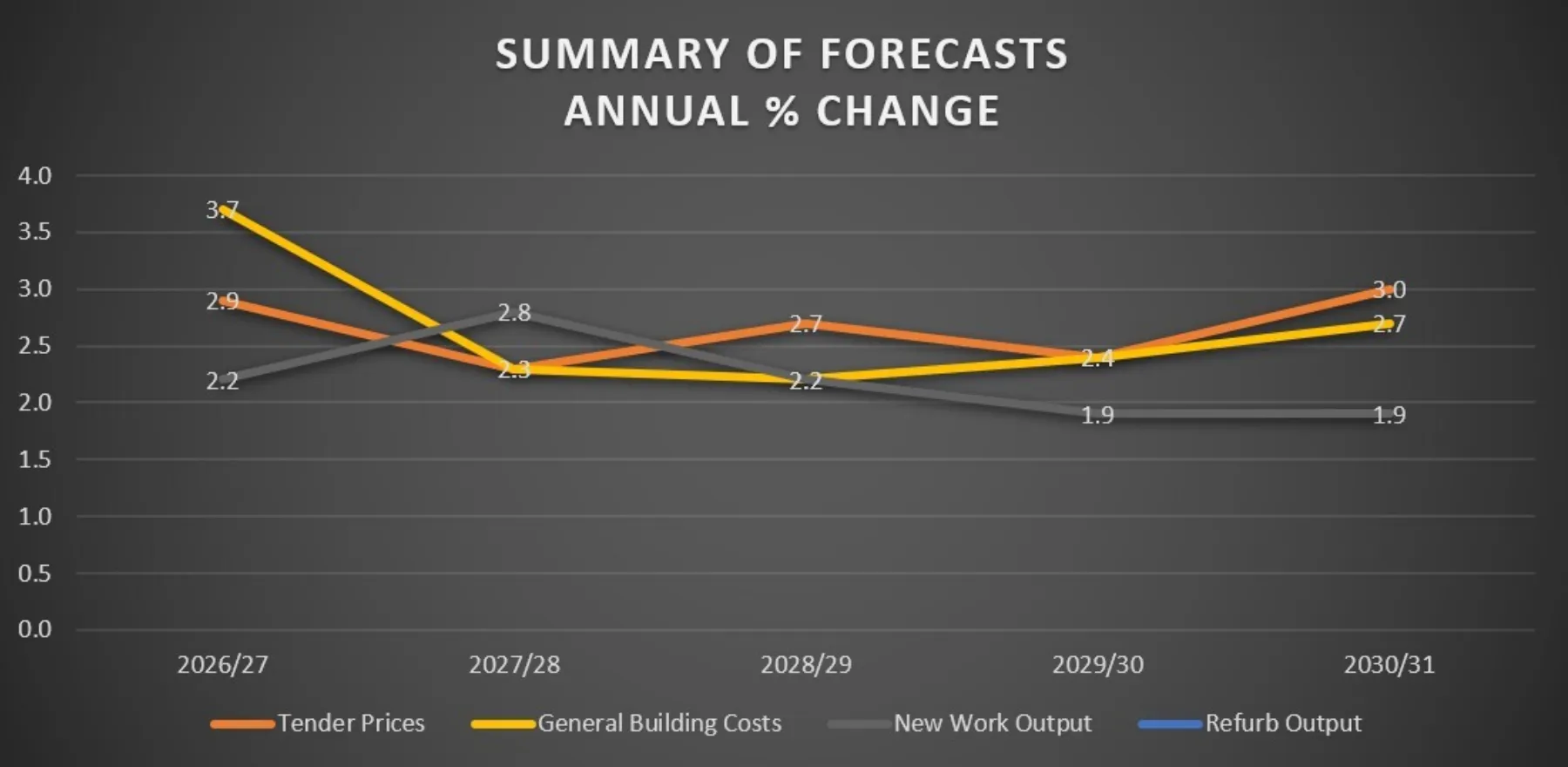
The forecast movements in construction costs and output currently shown in the BCIS Five-Year Forecast are as follows:
Construction Forecast
The BCIS forecast indicates that both building costs and tender prices will increase by approximately 14% between Q3 2026 and Q3 2031. In the near term, building costs are expected to rise faster than tender prices as competitive market conditions limit contractors’ ability to recover increased input costs.
The outlook for new work remains mixed. Total new-work output is forecast to decline by 3.7% in 2026 before recovering by 2.2% in 2027. Overall growth of 11.4% is forecast between 2026 and 2031.
High energy prices, elevated material costs, subdued workloads and intense competition continue to suppress tender price growth and constrain project viability. Demand is expected to recover gradually as these pressures ease.
The BCIS All-in Tender Price Index increased by 0.7% during Q3 of 2026 and by 3.2% over the year. Annual tender-price growth of 3.0% for Q4 of 2026, with cumulative growth of 14.1% forecast by Q3 2031.
Contractors continue to absorb many material increases arising from the ongoing Middle East conflict. Steel price pressures are particularly affecting industrial and logistics developments, while defence and healthcare investment is creating localised capacity constraints.
The General Building Cost Index increased by 1.6% in Q3 2026 and by 4.3% annually. Oil, gas, steel and copper prices remain key risks through fuel, transport, tariffs, quotas and demand from electric vehicles and AI infrastructure.
Higher energy prices are expected to place upward pressure on inflation and interest rates through late 2026. BCIS expects market conditions to improve from mid-2027 onwards, although the pace of recovery will depend heavily on commodity prices and wider economic conditions.

Labour Costs
Labour cost growth remains broadly aligned with inflation following the latest Construction Industry Joint Council (CIJC) pay agreement, which came into effect on 20 July 2026.
Labour costs are forecast to increase by 1.7% during the quarter and 2.9% over the year. Over the next five years, BCIS expects labour costs to rise by approximately 15.8%, representing only a marginal increase from the previous forecast.
Material Costs
Material costs continue to rise, particularly for aluminium, steel and fuel-related products.
The materials index is forecast to increase by 2.1% during the quarter and by 5.6% annually, significantly exceeding both general inflation and tender price growth. BCIS forecasts cumulative material cost growth of 12.5% over the current forecast period, with sustained energy costs representing the principal risk to the outlook.
Plant Costs
Fuel prices have eased from their April 2026 peak but remain substantially above pre-conflict levels. With no immediate resolution to geopolitical tensions, only a gradual reduction in costs can be expected.
The plant cost index is forecast to increase by 1.4% during the quarter and 6.0% over the year. Although this represents an improvement compared with earlier forecasts, plant costs are still expected to rise by 10.5% over the next five years, 3.3% higher than previously forecast.
Construction Output
According to the Office for National Statistics (ONS), UK construction output fell by 0.2% in August 2026 compared with July. New work declined by 0.7%, while repair and maintenance activity increased by 0.4%.
New public housing recorded the largest monthly decline at 3.8%, followed by public housing repair and maintenance, at 2.0%.
Compared with August 2025, total output was down 1.8%. New work fell by 5.8%, partly offset by a 3.6% increase in repair and maintenance activity. Infrastructure and private commercial developments were the only new-work sectors to record annual growth, increasing by 1.0% and 1.5% respectively. New public housing declined by 28.8%.
Construction Activity
The S&P Global UK Construction Purchasing Managers' Index (PMI) rose from 44.3 to 46.1, marking the slowest rate of contraction since January. Although activity remains below the growth threshold of 50, all three major sectors recorded slower declines.
Commercial construction performed best, recording its smallest fall since May 2025, while housing remained weakest.
Despite this improvement, new orders declined at their fastest rate for three months as investment decisions were delayed and input costs increased sharply. Demand for construction materials continued to weaken, extending a downturn that began in December 2024. Delivery times also lengthened due to international shipping disruption linked to the Middle East conflict.
While the improving PMI provides some encouragement, businesses continue to face falling workloads, rising costs and economic uncertainty. Confidence in recovery remains heavily dependent on government spending plans, infrastructure investment, borrowing costs and geopolitical developments.
Employment and subcontractor utilisation both declined. Looking ahead, 31% of industry respondents expect activity to increase over the next year, compared with 21% expecting a decline.
Industry bodies continue to call for stronger government support through housing and infrastructure commitments, greater certainty around future pipeline announcements, continued fuel-duty support and restraint on employment-related cost increases
Infrastructure
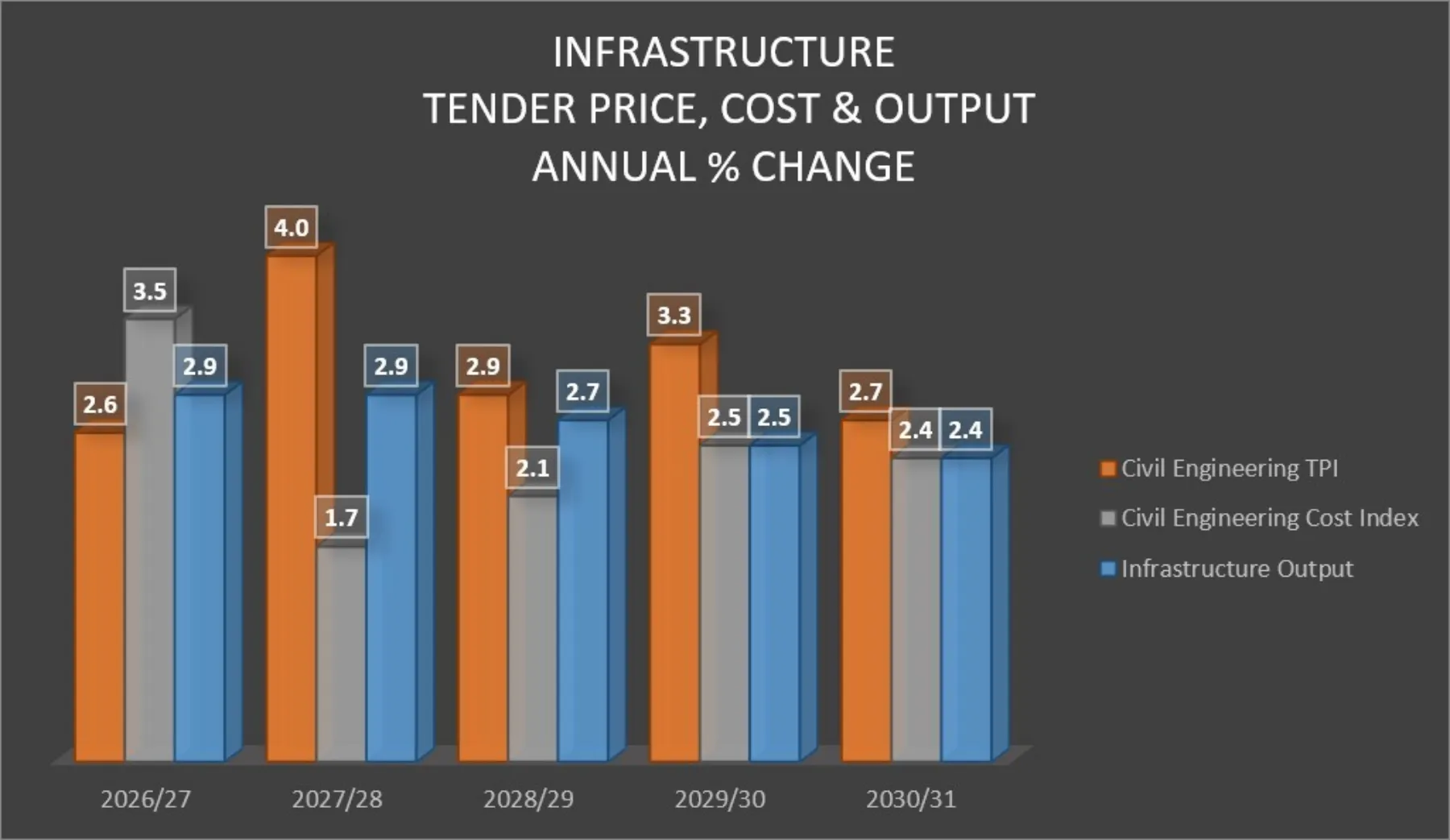
BCIS forecasts civil engineering costs to increase by 13% and tender prices by 16% by Q2 2031.
Infrastructure output is expected to decline by 1.4% in 2026 before recovering by 2.9% in 2027, delivering cumulative growth of 14.1% between 2026 and 2031.
The Civil Engineering Tender Price Index increased by 0.5% during Q2 2026 and by 2.1% annually. A further 1.0% increase was recorded in Q3 2026, taking annual growth to 2.6%. Tender price growth is expected to remain modest until the second half of 2027.
The General Civil Engineering Cost Index (GCECI) recorded its largest quarterly increase since 2022, rising by 3.2% in Q2 of 2026 and bringing annual growth to 5.6%. Materials and plant were the primary drivers, increasing by 5.2% and 4.6%, respectively.
High oil and gas prices continue to affect fuel, transport, and energy-intensive materials. Higher tariffs and lower import quotas are pushing up steel prices, while non-ferrous metals face supply constraints and strong demand from electric vehicles and AI infrastructure.
Infrastructure output grew by 1.9% in Q2 of 2026 after three quarterly declines, but remained 6.8% below a year earlier. Electricity, accounting for 41% of output, grew by 5% over the quarter. New orders fell by 5.1% quarter on quarter and by 22.5% annually.
Water, energy and defence-related projects continue to support cautious optimism, but funding constraints, affordability challenges and delivery capacity remain key risks.
Increasingly, clients and contractors are exploring cost-sharing arrangements and fluctuation clauses to manage uncertainty and protect project viability.
Forecasts for the next 5 years are shown in the graph below:
Facilities Management
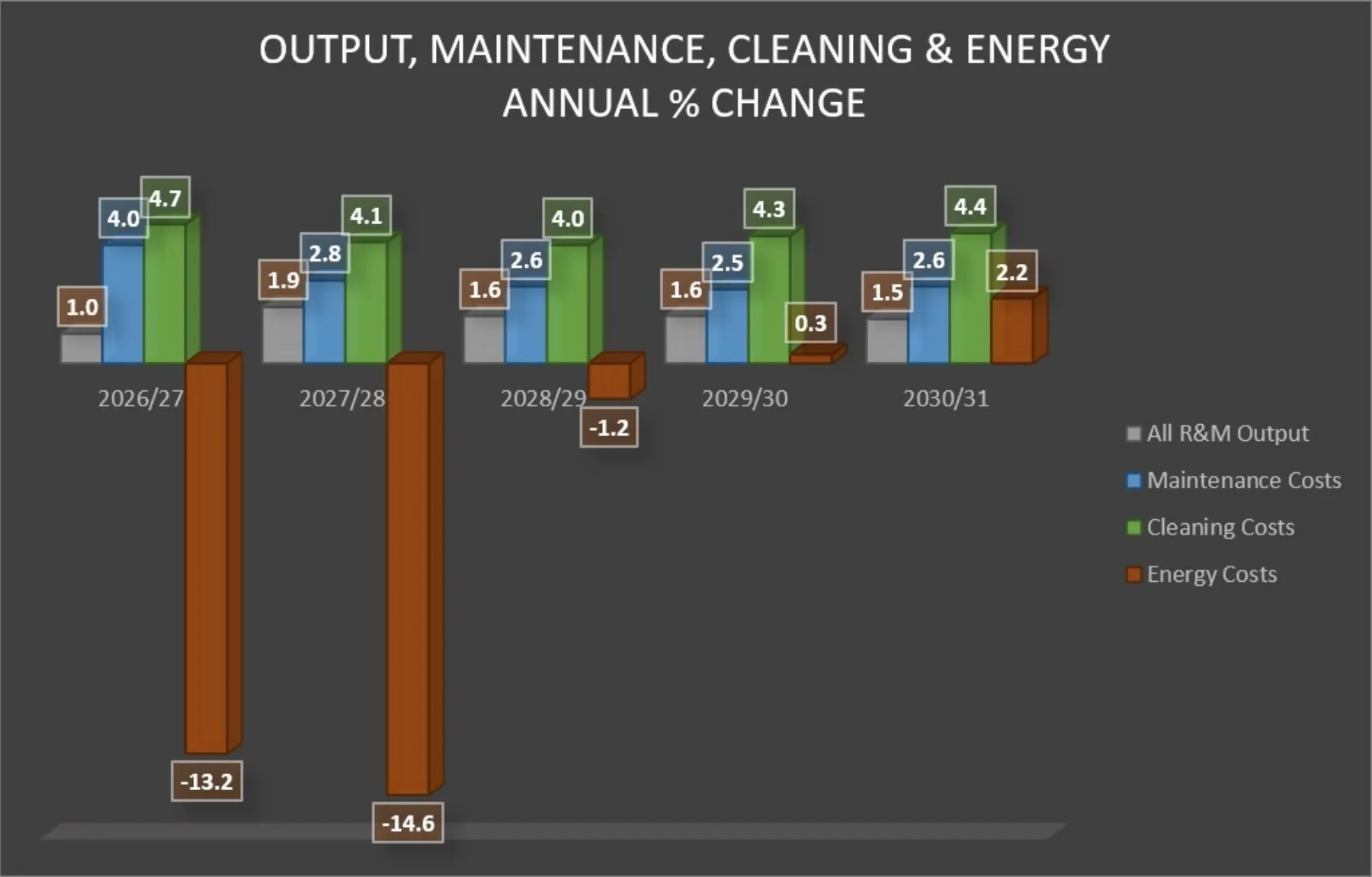
BCIS forecasts maintenance costs to increase by 15.3% over the five years to Q2 2031. Maintenance costs rose by 2.2% in Q2 2026 and by 4.3% annually.
Cleaning costs are expected to rise by 23.6% over the same five-year period, driven mainly by labour. They increased by 9.0% in the year to Q2 2026, with annual inflation forecast to remain around 4% or above through to Q2 2031. Cleaning labour costs are forecast to rise by 24.4% over the five years, compared with 7.6% for materials.
Facilities managers continue to face pressure from constrained budgets and volatile energy markets. Wage growth, increases in the National Living Wage and higher employer National Insurance contributions introduced in 2025 were the main labour-cost pressures. Slower inflation would moderate, not reverse, cost increases, requiring budgets to allow for sustained rises.
Repair and maintenance output is expected to grow steadily between 1% and 2% per year, resulting in cumulative growth of 7.8% between 2026 and 2031. Demand will continue to be supported by asset maintenance requirements, sustainability objectives and the need to extend asset life. Weak economic conditions and high financing costs are expected to limit near-term growth. Reliable benchmarking can help organisations assess cost movements, assess budgets, and inform procurement.
The BCIS Energy Cost Index is forecast to rise sharply in 2026 before falling in 2027 and 2028. However, energy remains the greatest area of uncertainty, and organisations should continue to test budgets and contracts against a range of pricing scenarios rather than assuming a smooth decline in costs.
Forecasts for the next 5 years are shown in the graph below:
Conclusion
Construction market conditions remain challenging. Material and labour costs are expected to rise over the next 12 months, while workload expectations remain mixed. High costs, delayed investment and funding constraints continue to hinder projects.
Budgets must reflect changing input costs, tender-market conditions and client affordability. Progress depends on funding, approvals and clients’ willingness to commit. Subdued workloads can encourage competitive bids, so clients need to understand allowances for future cost increases and the budget risks that remain.
Careful budgeting, early market engagement and realistic cost planning will remain critical to successful project delivery throughout 2027.
Sign up for news
Receive email updates from Thomson Gray direct to your inbox:
- Subscribe to Practice News
- Subscribe to Market Outlook